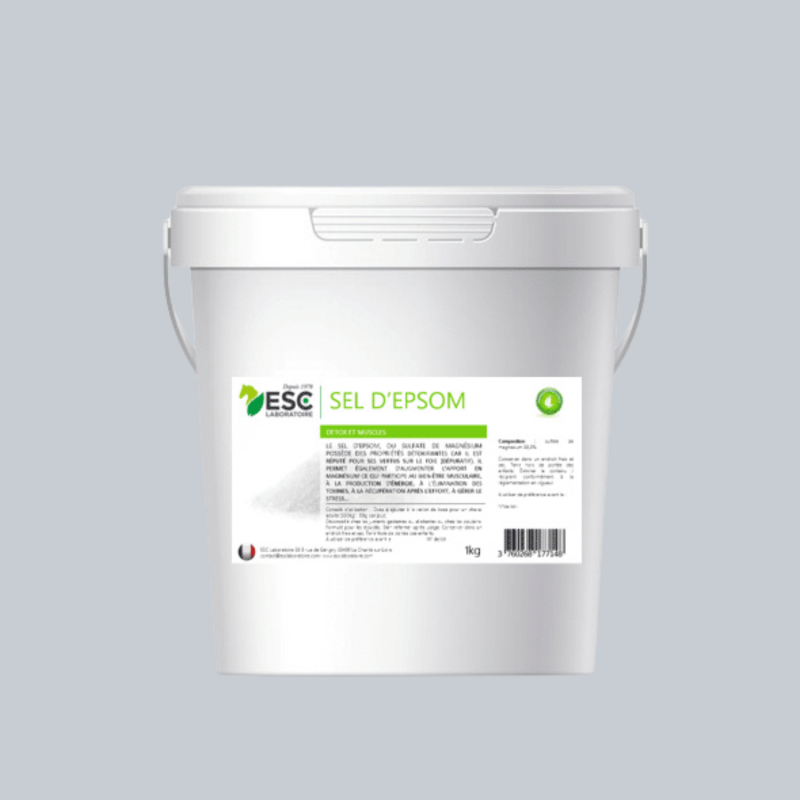


Epsom salts are recommended for intestinal discomfort, speeding up transit and softening dung. As a source of magnesium, they support nervous and muscular function. Externally, Epsom salts are useful in cases of engorgement or swelling.
Epsom salts are recommended in cases of intestinal discomfort, accelerating transit and helping to soften dung. As a source of magnesium, they support nervous and muscular function. Externally, Epsom salts are useful in cases of engorgement or swelling.
Epsom salt, or magnesium sulfate, is a white crystalline powder made up of 98% magnesium sulfate heptahydrate. Specifically, it's a mixture of magnesium, sulfide, oxygen and water.
Epsom salt occurs naturally in the waters of England's Epsom Fountain, from which it takes its name, but it can also be reconstituted from other compounds, such as Dolomite.
Although it has been used since antiquity, its history dates back to the 17th century, when the Epsom spring was used to relieve skin disorders and muscular pains.
Orally, the benefits of Epsom salt for horses are mainly digestive, notably in cases of slowed transit after ingesting large quantities of straw. Traditionally, it is also used as a depurative, thanks to its action on the liver. As a source of magnesium, it also contributes to muscular and nervous well-being.
Externally, it is beneficial in cases of local swelling, engorgement or muscle contractures.

Specific References
Epsom salts are recommended for intestinal discomfort, speeding up transit and softening dung. As a source of magnesium, they support nervous and muscular function. Externally, Epsom salts are useful in cases of engorgement or swelling.